Delta Wildfire Research Group

2025 Palisades Wildfire and the Burgum-Hart Tunnel
On the 7thJanuary 2025, a wildfire was reported in the vicinity of the Pacific Palisades in California. Initially covering approximately 10 acres, the fire spread quickly because of the severe drought conditions that most of Southern California had been subject to, as well as the strong Santa Ana winds. These dry, powerful winds originate inland and travel towards the Pacific coast, with gusts reaching speeds of up to 80 mph, creating highly favourable conditions for rapid wildfire growth and extreme fire behaviour. Within 20 minutes from the initial report the wildfire spread from 20 acres to 200 acres and by the afternoon of 7th January the wildfire was reported to have covered 1,200 acres of land, exacerbated by the steep terrain in the Santa Monica Mountains hindering firefighting efforts.
Over the following days, the fire spread aggressively across Los Angeles County, forcing more than 100,000 residents to evacuate their homes. As conditions worsened, additional fires such as Hurst and Kenneth fires were reported in separate areas of the mountain range from the original wildfire, placing enormous pressure on firefighters and emergency services. By mid-January the weather conditions began to improve slightly, allowing containment to strengthen. However, by then the damage had already devastating with over 16,000 structures being destroyed or damaged and an economic loss of tens of billions of US dollars. Finally, on 31stJanuary the California Wildfires were officially declared contained. But the events of that month highlighted not only the destructive power of wildfires, but also how the growing environmental and social challenges effect the be.
Delta Fire Engineering visited the Palisades to directly assess the wildfire’s impacts and to examine the extensive efforts required to contain them. Joe Hart, CEO of the Delta Innovation Group was stationed in California to observe and aid with the firefighting efforts as well as working with the local community in managing the incident. One of Joe’s main observations while in Los Angeles was the prominent presence of burning brands even from a considerable distance from the wildfire front. Burning brands are generated during wildfires and are a key mechanism for fire spread and structural ignition. A key consideration is their ability to ignite secondary fires at a significant distance from the fire front. However, their generation and transport remain poorly characterised under controlled conditions.
The potential for long-range firebrand transport became the focus of the Delta Wildfire Research Group, prompting the development of an experimental method to investigate this phenomenon under controlled laboratory conditions. Working late into the night with his colleague Katherine Burgum, Joe produced the initial design for the Burgum-Hart Tunnel. This experimental apparatus was developed to replicate key environmental conditions, including controlled airflow and varying fuel characteristics, allowing researchers to examine how burning embers are transported by wind, the distances they can travel, and their potential to ignite fuel sources away from the main fire front.

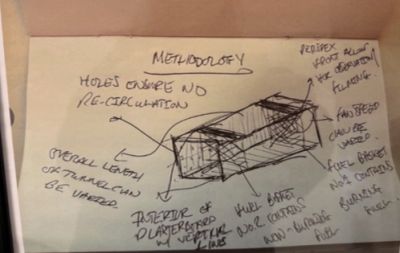
The Burgum-Hart Tunnel is a purpose-built, enclosed wind tunnel developed to investigate the generation, transport, and ignition potential of wildfire firebrands under controlled laboratory conditions. Measuring 2.4 metres in length, the apparatus uses a fan-driven airflow system to entrain burning embers from a controlled fuel source and transport them downstream, replicating the wind-driven conditions commonly experienced during wildfires. The tunnel was constructed using a timber frame to provide structural rigidity, with plasterboard panels fixed to the framework to create a fully enclosed test section. The enclosed plasterboard walls minimise disturbances from the surrounding laboratory environment, helping to maintain a controlled airflow throughout the apparatus.
A fuel bed with defined characteristics, such as low-moisture grass or other representative wildfire fuels, is placed within a wire fuel holder before being ignited and allowed to reach sustained combustion. The controlled airflow carries generated firebrands through the tunnel, enabling researchers to observe ember transport behaviour, travel distance, and their ability to ignite secondary fuel sources under repeatable experimental conditions. This controlled methodology provides valuable data to improve understanding of ember-driven fire spread and support the development of predictive wildfire models and operational mitigation strategies.
To complement the original design, a second Burgum-Hart Tunnel was developed with a reduced length of 1.2 metres. This modified configuration was created to investigate the influence of airflow dynamics over shorter transport distances and to better represent the turbulent wind conditions encountered in real wildfire environments. The shorter tunnel allows researchers to examine how changing airflow patterns affect firebrand dispersion, including the potential for embers to deviate from a single flow path and travel in multiple directions, providing further insight into the complex mechanisms of wildfire propagation.
The experiments produced several significant findings that contributed to a greater understanding of wind-driven wildfire behaviour. The introduction of forced airflow through the fan resulted in a measurable increase in flame intensity, accompanied by a visible change in flame angle and direction. This demonstrated the strong influence of wind on fire dynamics, particularly through increased oxygen supply, enhanced combustion, and the promotion of flame attachment to unburned fuel. In addition, increased airflow substantially accelerated the rate of fire spread across the fuel bed, highlighting the critical role wind plays in increasing wildfire propagation rates. The experiments also identified instances of secondary burning under forced airflow conditions, where transported embers and increased heat transfer contributed to additional fuel ignition and greater overall fire intensity.
These conditions were repeated consistently across multiple experiments, reinforcing several key factors known to influence wildfire behaviour: warmer temperatures, low relative humidity, the presence of flying embers, the amount of available fuel, wind direction and speed and the surrounding topography. Together, these conditions can dramatically increase both the intensity and spread of wildfires.
.jpg/:/rs=w:400,cg:true,m)
Aftermath – One Year On
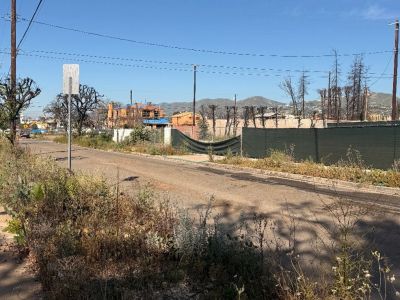
In January 2026, Joe Hart returned to Los Angeles to revisit the aftermath of the Pacific Palisades wildfire and assess the ongoing recovery efforts. More than a year after the incident, the area remained an active recovery zone, with conditions comparable to a large-scale construction site. The majority of properties affected by the wildfire had been demolished, with only a limited number undergoing reconstruction. Much of the neighbourhood had been transformed into a landscape of cleared plots, with former boundaries and landmarks becoming difficult to distinguish from one another. Despite the extensive destruction, remnants of the community that once existed remained visible throughout the area. Personal belongings, surviving structures, and familiar features of the landscape served as reminders of the lives, homes, and communities that were affected by the disaster.
The recovery process following an incident of this scale is complex and highly demanding, requiring extensive debris removal, environmental assessment, soil remediation, and infrastructure reconstruction. Restoring the neighbourhood involves not only rebuilding homes but also ensuring that the wider systems supporting the community are safe, resilient, and prepared for future hazards.
The 2025 Pacific Palisades wildfire was unprecedented in its scale and impact; however, it was not an unforeseeable event. A growing consensus among leading wildfire researchers is that large-scale conflagrations of this nature should not be viewed solely as rare, once-in-a-generation disasters, but as indicators of the evolving wildfire landscape. The conditions that contributed to this event represent a significant challenge for communities worldwide and highlight the urgent need for improved wildfire understanding, monitoring, prevention, and response capabilities.